You Can Try It Now

March 24, 2026
tl;dr

Since Last Time

Two days between posts. We went from alive actors to closures, pattern matching, loops, async scheduling, tagged values with Perceus RC, full LLVM compilation, a 100KB WASM module in the browser, and a canvas that paints actors as generative art. There's a REPL at the bottom of this page.

Last post the actors were alive. We had a tree-walking interpreter, an LLVM compiler that produced native binaries, a REPL with a state sidebar, and a diff viewer that watched the work happen. That was two days ago.

Since then we got closures, pattern matching, loops, an async scheduler, a tagged value runtime with Perceus reference counting, compiled all of it to native code via LLVM, put the entire interpreter in a browser as a 100KB WASM module, built a canvas that paints your actors as generative art, and embedded the whole thing in this blog.

There's a REPL at the bottom of this page. Go play with it.

Closures

First-class fn expressions that capture the enclosing scope. Unlocked map, filter, reduce, each as builtins that take closures. Store them, pass them, return them.

We have fn expressions now. They capture the enclosing scope and they're first-class values, you can store them in variables, pass them as arguments, return them from other functions.

This unlocked map, filter, reduce, and each as builtins that take closures.

double = fn(x) do x * 2 end
double(5)    # => 10

multiplier = 3
scale = fn(x) do x * multiplier end
scale(10)    # => 30

nums = [1, 2, 3, 4, 5]
map(nums, fn(x) do x * 10 end)
# => [10, 20, 30, 40, 50]

filter(nums, fn(x) do x > 2 end)
# => [3, 4, 5]

reduce(nums, 0, fn(acc, x) do acc + x end)
# => 15

The Dots

Three dots is map. Two dots is each. Use whichever reads best. Also got for/in if you want the verbose version.

We added two operators that I think are going to feel really natural once you get used to them.

Three dots is map:

Two dots is each (side effects, returns :ok):

And for/in is there too if you want the verbose version:

Three ways to say the same thing. Use whichever reads best for what you're doing.

double = fn(x) do x * 2 end
...[1, 2, 3], double    # => [2, 4, 6]

..[1, 2, 3], fn(x) do x end
# => :ok

for x in [10, 20, 30] do
  x + 1
end    # => [11, 21, 31]

Pattern Matching

Real structural pattern matching in situation and case. Variables bind, maps destructure, lists split head/tail. Atoms and literals match by value, identifiers bind, Holes are wildcards and agent prompts.

situation and case branches now do real structural pattern matching. Variables bind, maps destructure, lists split head and tail.

Atoms and literals match by value, identifiers bind, and holes always match. A Hole in a situation branch is the wildcard, the catch-all, and also the place where the agent shows up.

That _ with the comment is a Hole. The agent reads it, the program keeps running (Holes act as identity until filled), and you get suggestions without leaving your code. Patterns compose recursively so you can nest destructuring inside situation branches.

situation %{name: "bob", age: 30} do
  %{name: n, age: a} -> n
end    # => "bob"

situation [1, 2, 3] do
  [h | t] -> h
end    # => 1

situation {10, 20} do
  {a, b} -> a + b
end    # => 30

on :process(event) do
  situation event do
    :known -> handle(event)
    _ # Hole: figure out what to do
      # with unknown events
  end
end

Self

Inside a handler, self resolves to the current actor's ref. Actors send messages to themselves. The async scheduler handles self-sends inline to avoid deadlock.

Inside a handler, self resolves to the current actor's ref. So actors can send messages to themselves.

The async scheduler handles self-sends by processing them inline to avoid deadlock.

actor Doubler do
  state val: Int :: 0

  on :set(n) do
    become val: n
    reply n
  end

  on :double do
    self <- :set(val * 2)
    reply val
  end
end

d = spawn Doubler
d <- :set(5)
d <- :double
d <- :get_val    # val is now 10

The Async Scheduler

Enqueues messages in mailboxes, round-robin until reply comes back. Fair scheduling across actors. Deadlock detection aborts with a clear error instead of hanging. Single-threaded for now.

Speaking of which. blimp_send used to process messages inline, which meant no fairness and no real concurrency. Now it enqueues the message in the target's mailbox and pumps a round-robin scheduler until the reply comes back.

What that means: when actor A sends to actor B, and B's handler sends to actor C, all three get scheduled fairly. The scheduler does one message per actor per pass, round-robin. If two actors deadlock (A waits on B, B waits on A), it detects it and aborts with a clear error instead of hanging.

This is single-threaded for now. The WASM target will always be single-threaded (that's how browsers work). The native target will get real threads later, but the scheduler architecture is ready for it.

Tagged Values and Perceus RC

Every value is a BlimpVal* heap-allocated tagged union with a reference count. When it hits zero, recursive free. Perceus insight: refcount of 1 means you can mutate in place instead of allocating.

Under the hood, every value in compiled code is now a BlimpVal*, a heap-allocated tagged union. Integers, floats, strings, atoms, booleans, lists, maps, closures, actor refs, all the same pointer type.

And every BlimpVal has a reference count. When you bind a value to a variable, the count goes up. When a scope exits, the count goes down. When it hits zero, the value and all its children get freed recursively. Lists dec their elements, maps dec their values, closures dec their captured environment.

The Perceus insight: if the refcount is 1 (you're the only owner), you can mutate in place instead of allocating. become count: count + 1 doesn't need to allocate a new integer if the old one has refcount 1, it just overwrites it. We have blimp_rc_reuse in the runtime for this but we're not using it aggressively in codegen yet. That's an optimization pass for later.

Compiled to Native, All of It

LLVM compiler handles lists, closures, for loops, spread operators, and actor compilation. A single program spawns actors, defines closures, maps over lists, loops, all compiled to a native binary.

The LLVM compiler now handles lists, closures, for loops, and spread operators alongside the existing actor compilation. A single program can spawn actors, define closures, map over lists, and loop, all compiled to a native binary.

actor Counter do
  state count: Int :: 0
  on :increment do
    become count: count + 1
    reply count + 1
  end
end

c = spawn Counter
c <- :increment
c <- :increment
c <- :increment

nums = [10, 20, 30]
double = fn(x) do x * 2 end
result = ...nums, double

for x in result do
  x + 1
end

# Output:
# [21, 41, 61]

Blimp in the Browser

Interpreter compiles to 100KB WASM via Zig's wasm32-freestanding target. No Emscripten, no WASI. Tiny JS loader (80 lines) handles strings through linear memory. Three-function API: init, eval, getState. Embedded in this blog.

The interpreter compiles to a 100KB WASM module via Zig's native wasm32-freestanding target. No Emscripten, no WASI, no polyfills. Just the lexer, parser, evaluator, and actor runtime, compiled to WASM.

A tiny JS loader (blimp.js, 80 lines) handles loading the module, passing strings through linear memory, and wiring up print callbacks. The API is three functions: init, eval, getState.

We embedded it in this blog. There's a REPL at the bottom of every page. The playground at /blog/playground.html has the full setup: REPL, state panel, canvas, and a cheat sheet with copy-paste examples of every feature.

The Canvas

Actors are hexagons with fill patterns generated from SHA-256 hash of state. Same state, same visual. State transitions morph the pattern. Message sends animate as dashed rays with particles and impact rings. Generative art that IS the program.

This is the part where it gets weird and I love it.

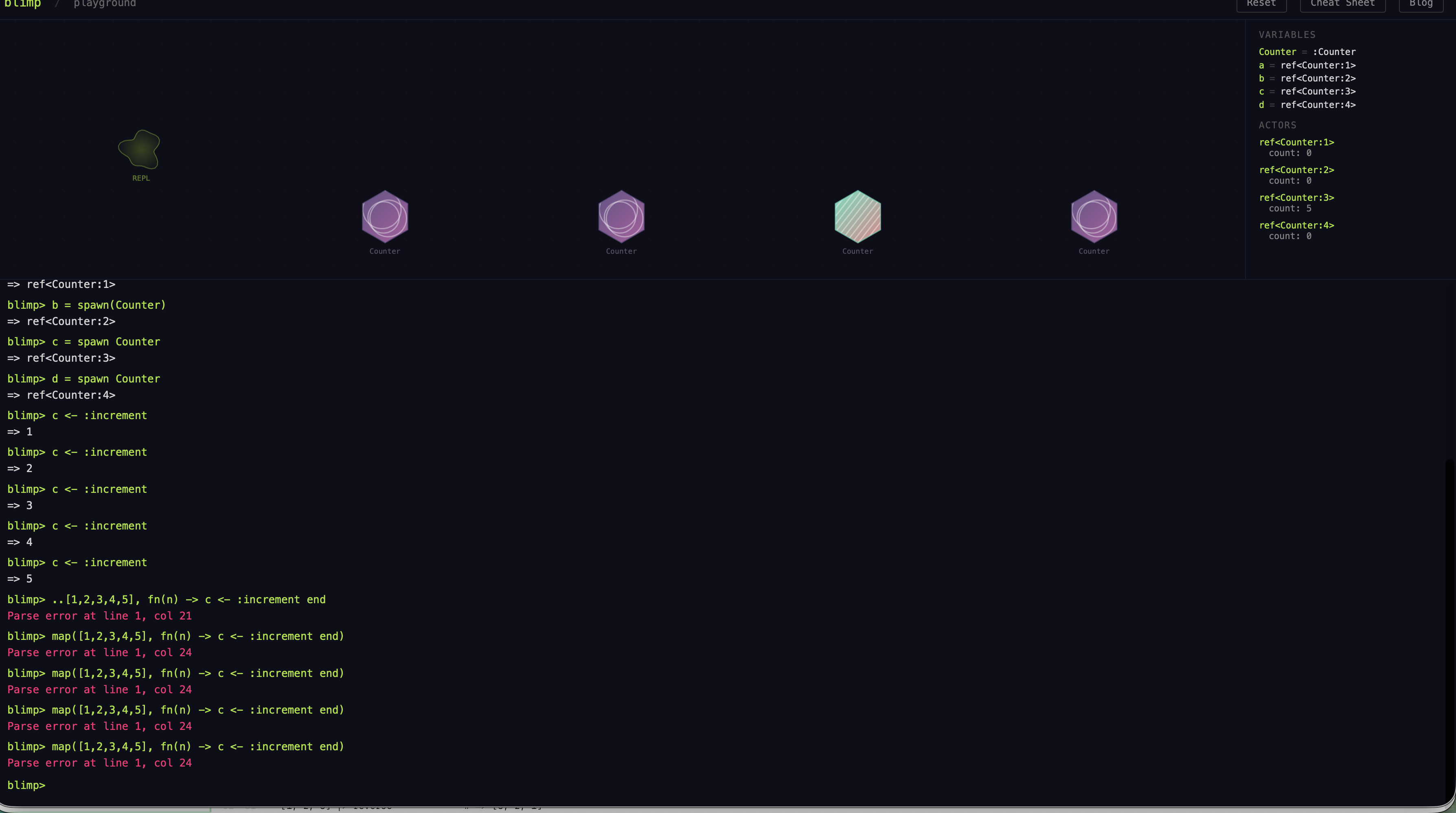
Every actor on the canvas is a hexagon. The hexagon's fill pattern is generated from a SHA-256 hash of the actor's state. Same type and same state produce the same visual. When state changes via become, the hash changes and the pattern morphs. You can literally see state transitions as color shifts.

Four pattern types: scattered dots, concentric rings, diagonal stripes, soft blobs. The hash determines which type and what parameters. Two counters both at count: 0 look identical. Increment one and they diverge visually.

When you send a message, a dashed ray animates from the green REPL blob to the target hexagon. The ray has a particle head that travels the path and an impact ring that pulses on arrival. The message name floats along the path.

Raw values (variables that aren't actors) get squares instead of hexagons. The layout adapts to any number of shapes, scaling down and using hex-grid packing when there are many.

It's generative art that IS the program. The program paints itself.

The playground canvas showing multiple counter actors as hexagons with different fill patterns

What's Next

Still need: def for named functions inside actors, string operations as builtins, supervision so bubbles propagate and restart actors, send_after for timers, a UI DSL that wraps Tailwind so you can build interfaces from Blimp. Actors all the way down.

We still don't have:

That last one is the one I keep thinking about. If actors are the runtime and the browser is the target, then the language should be able to describe interfaces. Not with JSX, not with templates. With actors. A button is an actor. A form is an actor. The page is a supervision tree. Clicks are messages.

We'll see. For now, go try the REPL.
try blimp

Open Playground with Demo